
Every week I walk a San Antonio house and find a crack that has someone worried. Most of the time it is cosmetic. Some of the time it is the first sign of foundation movement. The hard part is telling the two apart, because the signs of foundation problems in a house are usually small, slow, and easy to explain away. This note is about the signs I actually look for, what is normal in a Texas house, and when a sign deserves a call to a structural engineer.
Where the signs of foundation problems show up first
Foundation movement rarely announces itself. It shows up as a crack that was not there last spring, a door that started sticking in August, a window that suddenly needs a shoulder. In San Antonio, most of that movement traces back to the expansive clay soil under the slab, the same ground that swells when it rains and shrinks when it dries. The signs look the same whether you are in an older Alamo Heights home, a newer Stone Oak build, or a Hill Country house in Boerne or Bulverde, so it pays to know what you are looking at.
The cracks to look at, and the cracks to ignore
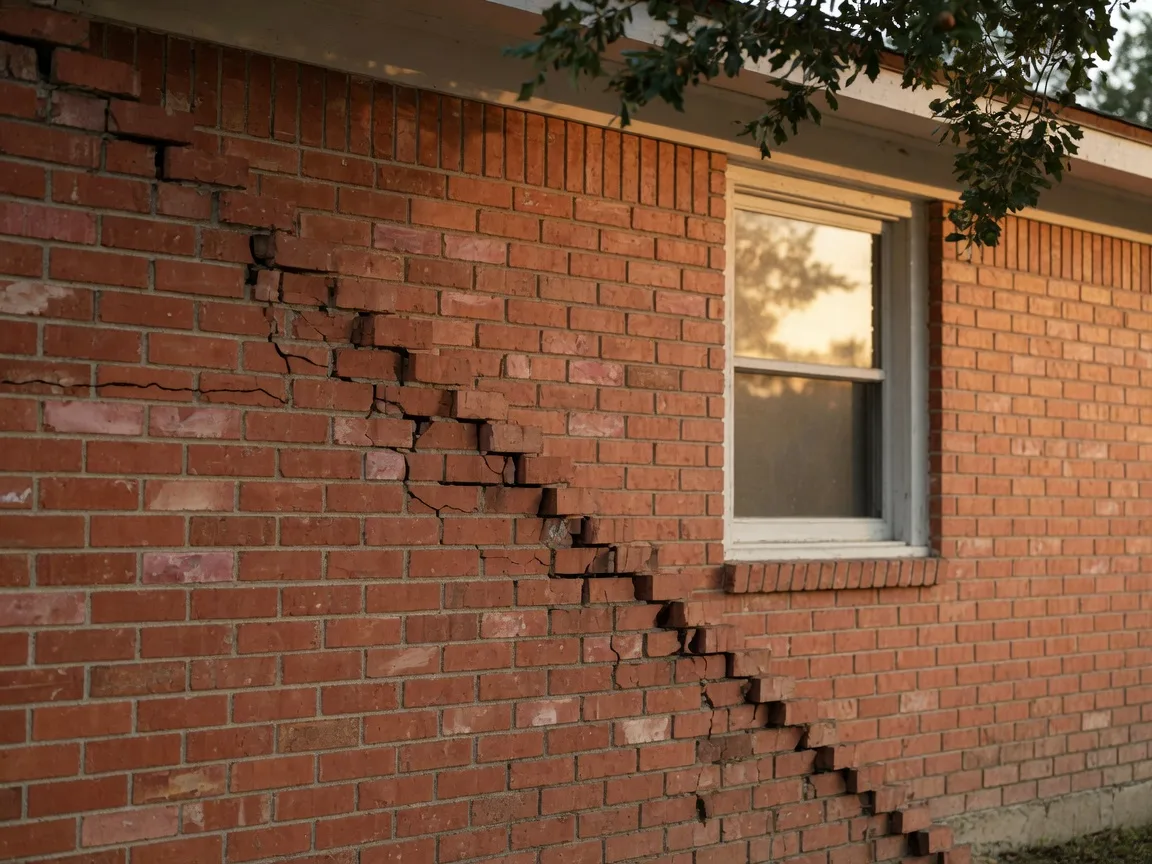
Cracks are the most common sign, and the easiest to misread. A single hairline crack in drywall, especially over a door or window, is normal in Texas and usually cosmetic. A short stair-step crack in brick veneer can sit stable for decades. What changes the math is behavior: a crack that keeps widening, a crack that is noticeably wider at one end, or several cracks appearing at once. Those are the cracks worth taking seriously.
- Stair-step cracks in brick or stone veneer that keep growing, or gaps where the veneer pulls away from a window or door frame
- Interior cracks around doors and windows that are wider at the top or bottom than in the middle
- Doors that stick, swing open on their own, or no longer latch, and windows that have become hard to close
- Floors that slope or bounce underfoot and thresholds that pull away from the slab
- Chimneys or porches separating from the main house
- Cracks that appear or widen right after a hard rain
What is normal in a Texas house
Here is the honest part. Almost every house in San Antonio has some of this. Hairline cracks, a door that sticks in the humid months, a hairline gap at a window frame: this is the background noise of a house settling on clay soil, and most of it never turns into anything. Normal is a crack that stays the same size, a door that has always been a little tight, a floor that has not changed. The house is not trying to tell you something new.
What is not normal
What earns a call is change. A crack that grows between seasons, a door that suddenly stops fitting, a floor that keeps sloping, or several of these signs showing up in the same part of the house. When movement is happening, it usually shows up in more than one place, and it usually shows up on the same side of the house, often the side with the worst drainage. That pattern is what separates a settling house from a foundation problem.
Why the ground matters from Stone Oak to Canyon Lake
The soil story changes as you move around the metro. In Stone Oak, Schertz, and Cibolo, newer homes sit on clay that is still finding its footing, and the first few years of settling are common. In Alamo Heights and the inner loop, you are looking at decades of movement on older slabs. Out toward Boerne, Bulverde, and the Hill Country, the ground turns to limestone and caliche, which drains better but can still shift on slopes. And around New Braunfels and Canyon Lake, the water table and the rivers keep the soil moist, which brings its own movement. The signs are the same; the context is different. That is why the inspection matters everywhere across the metro.
Want the deeper story on the soil under San Antonio? We wrote about why the clay moves and when to worry: Why San Antonio foundations crack, and when to worry
What to do when you see them
First, do not panic, and do not let anyone sell you a repair on the spot. Take photos, note the date, and watch whether the crack changes over a few weeks. A home inspection is a visual, non-invasive look: it can tell you that movement is happening, where it shows up, and whether the drainage is making it worse. If the signs are real, the report will point you to a structural engineer, who measures, monitors, and gives the definitive answer on whether a foundation needs repair. That handoff is the system working, not the inspection falling short.
The takeaway
The signs of foundation problems in a house are rarely dramatic. They are a crack that grows, a door that stops fitting, a floor that shifts, and they are worth understanding before you close, not after. If you are in the option period with a foundation question on your mind, an inspection is exactly the tool for that moment. Book yours, walk the house with me, and get the straight story on the slab before you sign.
Ready to book? Bring your foundation questions along, walk the house with me, and leave with the straight story on the slab. Book your inspection
Christian Schmeis
Certified Professional Real Estate Inspector and owner of Rodeo Home Inspections LLC. Two decades in construction, now inspecting San Antonio’s homes full time.