
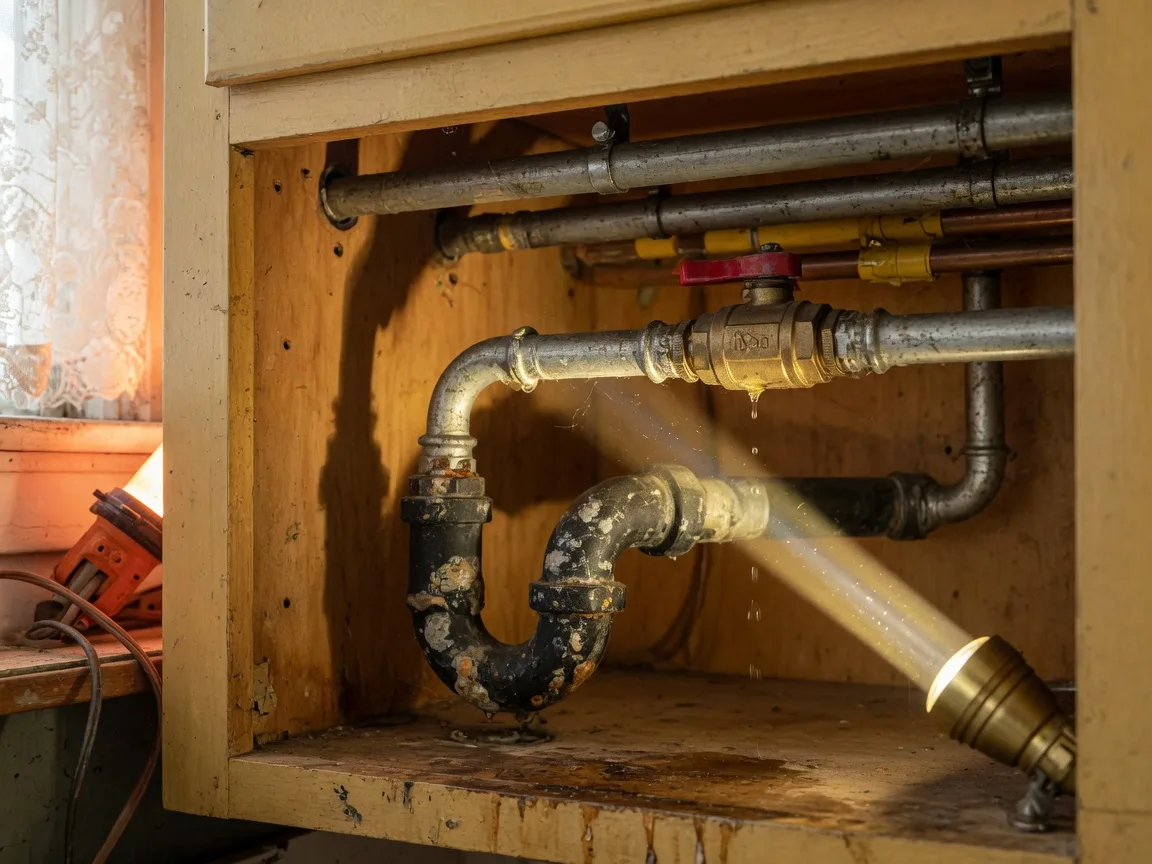
Older San Antonio homes have a plumbing story worth reading before you sign. Galvanized supply lines, clay drain tile, hard water, and decades of Texas summers all leave their mark on the pipes, and most of that history is hidden inside walls and under slabs. This note covers the plumbing issues in older San Antonio homes I see most, what they mean for the house, and which ones are worth negotiating during your option period.
Plumbing issues in older San Antonio homes start with the pipe itself
If the house was built before the mid-1980s, the supply lines are likely galvanized steel. Galvanized pipe was the workhorse of its day, but it corrodes from the inside out. Over the years the buildup closes the pipe down, pressure drops at the fixtures, and rust flakes into the water. A house that feels great when you visit can be running on a supply system with years left or months left, and you cannot tell from the faucet. This is the single most common plumbing issue I flag in older homes across the metro, from the bungalows of Alamo Heights to the brick ranches of Schertz and Cibolo.
The water heater is on a clock
A water heater in San Antonio works against hard water, sediment, and heat, and it lives a shorter life than most buyers expect. If the unit is past eight to ten years old, it is running on borrowed time. I check the age stamp, the fittings, the pressure relief valve, and the pan and drain line. A rusted tank, a leaking valve, or water stains around the base are the heater telling you it is close to done. Replacing one runs a few hundred to a couple thousand dollars depending on the unit, so its age belongs on your list before you negotiate.
Clay drain lines and the roots that find them
Older San Antonio homes often still carry their waste through clay tile sewer lines. Clay serves well for a long time, then it does not. Joints shift, roots work into the seams, and the line starts moving water and soil it was never meant to. A slow drain, a gurgling toilet, or a soft wet spot in the yard can all be the sewer line talking. That is why I recommend a sewer scope on older homes, especially in established neighborhoods where the lines are old and the trees are older.
A sewer scope is a separate camera run through the main line, and it is worth every minute on an older house. Here is how it works and when buyers should order one: Read the sewer scope notes
The leaks that hide under the slab
Many San Antonio homes, older and newer, run their supply lines beneath the slab. When those pipes fail, the water does not drip where you can see it, it soaks into the foundation. Slab leaks show up as warm spots on the floor, a water bill that climbs for no reason, or foundation movement that does not match the pattern on the street. A slab leak is one of the more serious plumbing issues in older San Antonio homes because it touches the foundation, and fixing it means cutting concrete. If the report flags one, that is a conversation worth having with a licensed plumber before closing.
What a plumbing inspection actually checks
- Supply lines: material, condition, and visible corrosion on galvanized or copper runs
- Water heater: age, tank condition, relief valve, pan, and drain
- Fixtures: running water at every sink, tub, and shower to confirm pressure and drainage
- Shut-off valves: present, reachable, and working at the fixtures and the main
- Visible drain and vent lines: leaks, sags, and signs of past repairs
- Exterior hose bibs and irrigation connections: leaks and backflow hazards
I also note the plumbing I cannot see. A home inspection is visual and operational, so what lives inside the walls and under the slab is documented as a limitation. That is standard practice, and it is exactly why a sewer scope and, when the report calls for it, a licensed plumber's evaluation are the smart follow-ups on an older house.
What to do when the report flags plumbing
Plumbing findings are usually fixable, and in the option period they are negotiable. The question is priority. A leaking shut-off valve is a small repair. A water heater at the end of its life is a real cost. A slab leak or a failing sewer line is a big-ticket item that deserves a credit or an adjustment in price. Whether the house is a 1960s brick ranch in Alamo Heights, a newer build in Stone Oak, or a Hill Country place outside Boerne or Bulverde with a well and septic, the plumbing story is part of the price. The same holds in New Braunfels and Canyon Lake, where water systems work harder near the rivers and the lake.
The takeaway
Plumbing in an older home is not a reason to walk away, it is a reason to know what you are buying. The report tells you what is visible, what is aging, and what is worth negotiating, and a few targeted follow-ups tell you the rest. If you are under contract on an older San Antonio home right now, the inspection is the first step, and the plumbing is one of the first things I look at. Book your inspection and get the straight story on the pipes before you commit.
Christian Schmeis
Certified Professional Real Estate Inspector and owner of Rodeo Home Inspections LLC. Two decades in construction, now inspecting San Antonio’s homes full time.